Each year, forty days after Easter, the Church celebrates the Ascension of the Lord — a feast of hope, mission, and promise.
In 2026, it will be celebrated on May 14, or May 17 depending on your diocese.
Forty days after Easter, we lift our eyes with the apostles and witness the Lord’s return to the Father. It is a feast of triumph — and a call to live what has been entrusted to us.
Yet the Ascension can feel like a feast of absence — Jesus is gone, and the disciples are left standing and looking up at the sky. But the Church invites us to see it differently. The Ascension is not an ending. It is the beginning of everything that comes next.
Jesus did not ascend to abandon us. He ascended to prepare a place for us — and to send us the gift he promised: the Holy Spirit.
Prepare your heart with our Feast of the Ascension Novena — begin May 5 to finish on the eve of the feast.
When Is the Ascension of the Lord in 2026?
The Ascension of the Lord is celebrated on:
- Thursday, May 14, 2026 — the traditional date, forty days after Easter
- In some dioceses, it is transferred to Sunday, May 17, 2026
- Ascension Novena begins: May 5, 2026
These forty days echo the time Jesus spent with His disciples after the Resurrection — teaching, appearing to them, and preparing them for the coming of the Holy Spirit.
What Is the Ascension of Jesus?
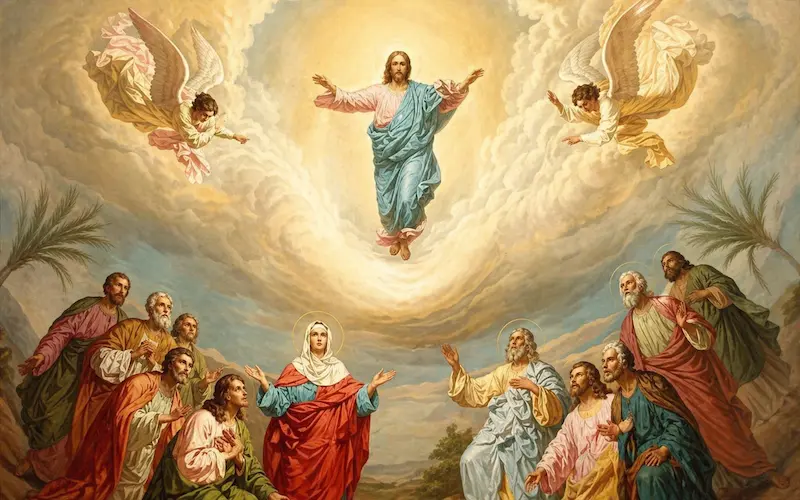
The Ascension is the event recorded in the Acts of the Apostles and the Gospel of Luke, in which Jesus — forty days after his Resurrection — led his disciples to the Mount of Olives outside Jerusalem, blessed them, and was taken up into heaven before their eyes.
Two angels appeared and said to the disciples: “Men of Galilee, why do you stand looking up toward heaven? This Jesus, who has been taken up from you into heaven, will come in the same way as you saw him go into heaven.” (Acts 1:11)
The Ascension marks the completion of Christ’s earthly mission. He who became flesh, suffered, died, and rose from the dead now returns to the Father — but not without us. He takes our human nature with him into the heart of the Trinity. As the Catechism of the Catholic Church teaches, wherever the Head has gone, the Body hopes to follow.
What the Ascension Means for Us Today
The Ascension is far more than a departure. It carries several layers of meaning that the Church invites us to contemplate:
- Christ intercedes for us
In ascending to the Father, Jesus does not leave us alone — he enters into the heavenly sanctuary to intercede for us continuously. As the Letter to the Hebrews tells us, he lives forever to make intercession for those who approach God through him. - He prepares a place for us
At the Last Supper, Jesus told his disciples: “In my Father’s house there are many dwelling places. I go to prepare a place for you.” (John 14:2) The Ascension is the fulfillment of that promise. - The Holy Spirit is given
Jesus told the disciples that it was better for them that he go — because only then would the Advocate, the Holy Spirit, come. The Ascension opens the door to Pentecost. - We receive a mission
Before ascending, Jesus gave his disciples the Great Commission: “Go therefore and make disciples of all nations.” (Matthew 28:19) The Ascension is the moment the Church receives her mission in the world.
How to Celebrate the Ascension of the Lord
The feast of the Ascension invites us to celebrate with both joy and intentionality:
- Begin the Novena on May 5 — nine days of prayer that carry you from the joy of Easter to the threshold of Pentecost
- Attend Mass on May 14 — or on the Sunday it is transferred to in your diocese
- Pray the Creed slowly — “He ascended into heaven and is seated at the right hand of the Father” — let those words land with their full weight
- Read Acts 1:1–11 — the account of the Ascension, simple and powerful
- Lift your eyes in prayer — spend a few moments in silence, aware that Christ is interceding for you right now before the Father
- Prepare for Pentecost — the Ascension begins the nine days of waiting for the Holy Spirit. Consider beginning a Novena to the Holy Spirit on May 15
The Ascension and the Month of Mary
The Ascension falls in May — the month dedicated to the Blessed Virgin Mary.
After the Ascension, Mary remained with the apostles in prayer, waiting for the coming of the Holy Spirit. She who was present at the Annunciation, at the Cross, and at Pentecost — was present here too, in the waiting.
As you honor Our Lady this May, let the Ascension deepen your prayer. Mary knew how to wait with faith. She can teach us the same.
Explore: Month of Mary: Catholic Devotions and Prayers for May
Continue the journey: Pentecost 2026 — Meaning, Date, and How to Celebrate
A Prayer for the Feast of the Ascension
Lord Jesus,
you ascended not to leave us,
but to go before us —
to prepare a place for us.
Teach us not to remain looking at the sky,
but to live the mission you entrusted to us.
Send us your Holy Spirit,
and strengthen our hearts with hope,
until the day we are united with you in glory.
Amen.
Scripture for the Ascension
“He was lifted up, and a cloud took him out of their sight.” — Acts 1:9
“I go to prepare a place for you… I will come again.” — John 14:2–3
“He ascended far above all the heavens, that he might fill all things.” — Ephesians 4:10
Common Questions About the Ascension
In many dioceses, yes. In others, it is transferred to Sunday. Check with your local parish.
The Acts of the Apostles tells us that Jesus appeared to his disciples for forty days after the Resurrection before ascending. The number forty in Scripture consistently marks a period of preparation and transition — from Moses on Sinai to Jesus in the desert.
Jesus told his disciples that he had to go so that the Holy Spirit could come. The Ascension opens the nine days of waiting — the first novena in the history of the Church — that lead to Pentecost.
On the Mount of Olives, near Jerusalem, where Jesus blessed His disciples before ascending into heaven.
Related Articles
- Novena to the Ascension of the Lord
- Holy Spirit Novena
- Pentecost 2026 — Meaning, Date, and How to Celebrate
- Month of Mary Devotions