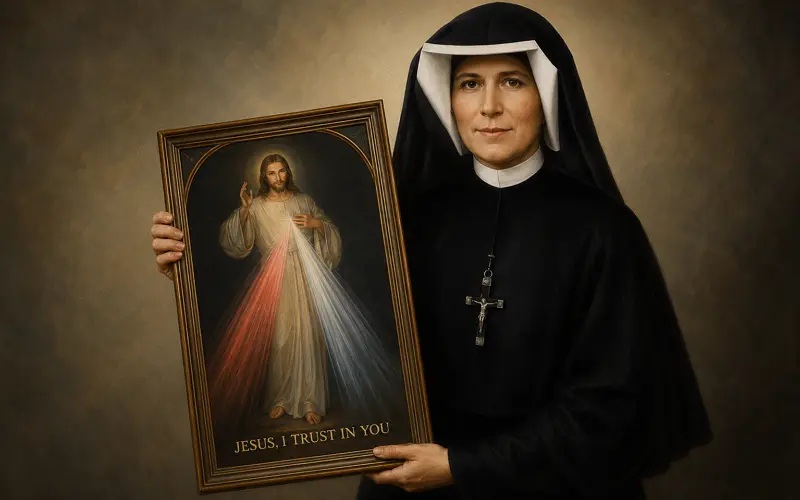
The Divine Mercy image is one of the most recognizable symbols of modern Catholic devotion. Every time we look at it, we meet the same gaze: Christ’s hand raised in blessing, His other hand resting near His Heart, and two rays—one pale, one red—pouring out toward us. Behind that simple image lies a story of visions, obedience, and a promise Jesus Himself asked to be painted and shared with the whole world.
Historical and Theological Context
In 1931, Jesus appeared to Sister Faustina Kowalska in Płock, Poland, dressed in white, His right hand raised in blessing and His left hand touching His garment near His Heart. From there, two rays streamed out — one pale, one red. He asked her to have an image painted according to what she saw, with the signature “Jesus, I trust in You,” and promised that souls who venerated it would not perish. Her confessor, Blessed Father Michael Sopoćko, commissioned the first version from painter Eugeniusz Kazimirowski, completed in Vilnius in 1934 under the direct guidance of Sister Faustina and Father Sopoćko. This first image became the foundation of a devotion that would later spread throughout the entire world.
Meaning for Us Today
The image is never meant to be admired as a work of art alone. Every detail carries a message we’re invited to receive personally:
- The raised hand is a blessing offered to whoever stands before the image, not a distant gesture.
- The two rays represent the blood and the water that poured from Christ’s pierced Heart on the Cross — the blood as the life of our souls, the water as the grace that cleanses and sanctifies our souls.
- The downward gaze, as Sister Faustina described it, mirrors “My gaze from the Cross” — mercy looking directly at our weakness.
- The words beneath the image, “Jesus, I trust in You,” are not decoration. They are the whole devotion condensed into a single act of surrender.
A second, widely reproduced version was painted in 1943 by Adolf Hyła as a votive offering after his family survived the Second World War. The Sisters of Our Lady of Mercy in Kraków gave him a copy of the original Vilnius painting along with passages from Sister Faustina’s diary to guide his work. Hyła’s version — softer in tone, with Christ appearing to step forward — became the image most familiar to households, parish churches, and holy cards throughout Europe and Latin America, and it’s very likely the one many of us grew up seeing at home.
Today, both images are venerated by the faithful. However, the original painting by Eugeniusz Kazimirowski remains the first image created under Saint Faustina’s direct guidance.
Practical Ways to Live This Devotion
- Keep an image of the Divine Mercy somewhere visible in your home, as Jesus asked, not stored away.
- Pause before it in moments of fear or discouragement, and simply say, “Jesus, I trust in You.”
- Pray the Chaplet of Divine Mercy, especially at 3:00 p.m., the Hour of Great Mercy.
- Bring the image to mind — not just as art, but as an invitation — when we feel unworthy of forgiveness.
- Teach children the meaning of the rays, so the image becomes a doorway to prayer rather than a mere picture on the wall.
Scripture and the Saint’s Own Words
Sister Faustina recorded in her diary the words that accompanied the vision: “These two rays issued forth from the very depths of My tender mercy when My agonized Heart was opened by a lance on the Cross” (Diary, 299). Her account echoes the Gospel scene where blood and water flowed from Christ’s side (John 19:34) — the same wound now offered to us as a fountain of mercy rather than only a moment of suffering.
A Short Prayer
Lord Jesus, You showed Sister Faustina Your Heart so that we would never doubt Your mercy. When fear tells us we are too far gone, let us return to those two rays and simply say, with our whole heart: Jesus, I trust in You. Amen.
Continue Your Divine Mercy Devotion
The Divine Mercy image points us to Christ’s infinite mercy. Continue exploring the devotion through prayer and reflection.
- Divine Mercy — Discover the heart of the Divine Mercy devotion and explore its prayers, feast, and message of hope.
- Divine Mercy Chaplet — Pray the Chaplet Jesus entrusted to Saint Faustina and place yourself in His infinite mercy.
- Saint Faustina Kowalska — Meet the humble Polish nun chosen to share Christ’s message of Divine Mercy with the world.
- Divine Mercy Novena — Prepare your heart for Divine Mercy Sunday through nine days of prayer and trust.