He had never seen a sunrise.
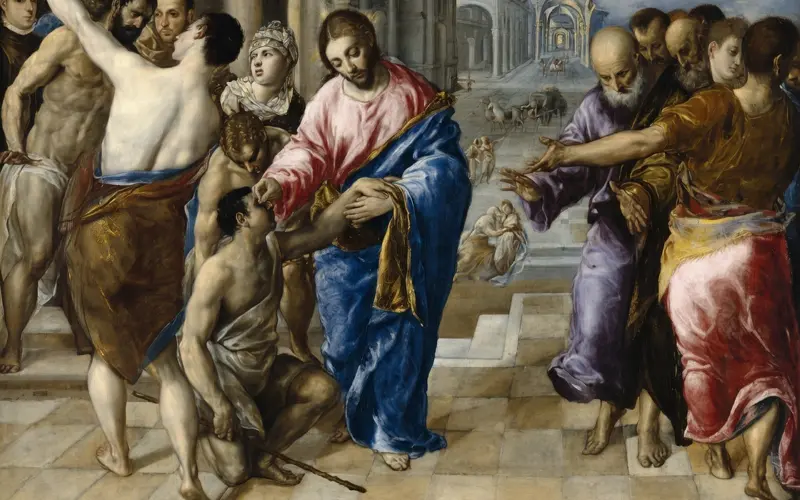
He had never seen his mother’s face. He had never seen the Temple, or the lake, or the color of the sky at dusk. He had been sitting in darkness since before he could remember — and everyone around him had already decided why.
“Who sinned,” the disciples asked, “this man or his parents?”
Jesus didn’t answer the question. He dissolved it.
“Neither. He was born blind so that the works of God might be displayed in him.”
The fourth week of Lent does not ask you to go deeper into darkness.
It asks you to open your eyes.
Historical and Theological Context
The Fourth Week of Lent has always been a turning point in the ancient liturgical tradition. In the early Church, this was the week of the second major scrutiny — a solemn rite of prayer and exorcism for the catechumens preparing for baptism. The community gathered, laid hands on them, and prayed for the removal of whatever still obscured the light of faith.
The Gospel of the Man Born Blind (John 9:1–41) was chosen for this moment deliberately. Blindness in Scripture is never merely physical — it is a portrait of the soul that cannot yet see God clearly. But the miracle in this passage is not only the healing. It is the progressive recognition: the man moves from calling Jesus “a man,” to “a prophet,” to “Lord” — a journey of deepening sight that mirrors the Lenten journey itself.
This year, Lent 2026 runs from Ash Wednesday, February 18 through Holy Saturday, April 4. We are now past the midpoint — closer to Easter than to the beginning.
What the Fourth Week of Lent Means for Catholics Today
By the fourth week, something has shifted. The desert is no longer unfamiliar. You know its rhythms now — the dryness, the resistance, the small faithfulnesses that no one sees.
This week the Church places light at the center. Not as a reward for those who have done Lent perfectly — but as a gift offered to those who are still sitting in the dust, still waiting, still not entirely sure they deserve to be healed.
The man born blind did nothing to earn his miracle. He simply responded when Jesus acted. He washed when he was told to wash. He testified when he was questioned. And when he was thrown out of the synagogue for telling the truth, Jesus went looking for him.
That is the movement of this week: not striving harder, but allowing yourself to be found.
Practical Ways to Live This Fourth Week Well
- Ask yourself what you have stopped seeing. Not physically — but spiritually. What truth have you been avoiding? What person have you stopped really looking at? This week, open your eyes to one thing you have been keeping in the dark.
- Read John 9:1–41 slowly. Follow the man’s journey of recognition. At what point in his story do you recognize yourself — the blindness, the healing, the interrogation, or the moment Jesus finds him again?
- Fast from judgment. The disciples’ first instinct was to assign blame. This week, notice every time you do the same — with others, and with yourself — and choose differently.
- Let yourself be found. The man didn’t go looking for Jesus after the healing. Jesus went looking for him. Is there an area of your life where you have been hiding, waiting to be worthy enough to return? This week, stop waiting.
- Do one act of charity in secret. The works of God are displayed not in grand gestures but in hidden ones. Give something this week that no one will know about — and let that be enough.
- Pray for someone who is spiritually blind. Someone in your life who cannot yet see what you can see. Don’t argue with them. Just pray for them, by name, every day this week.
- Go to Confession before Holy Week. We are now close enough that waiting is a choice. The sacrament is not a reward for those who have their lives in order — it is the mud and the water Jesus uses to open our eyes.
Scripture to Carry This Week
“Neither this man nor his parents sinned. He was born blind so that the works of God might be displayed in him.” — John 9:3
“I am the light of the world.” — John 9:5
A Short Prayer for the Fourth Week of Lent
Lord,
There are things I have not wanted to see. Truths I have walked around carefully, blindnesses I have learned to call by other names.
This week, I ask for the grace of sight.
Not the sight that judges, not the sight that compares — but the sight that sees as You see: clearly, mercifully, without conditions.
Open my eyes. And if I am not ready to see everything yet, open them to just one thing — one truth, one person, one grace I have been missing.
I trust that You are already looking for me.
Amen.
As Lent continues, the Church gently prepares our hearts for the sacred days of Holy Week — when we will remember the Passion, death, and Resurrection of Christ.
👉 See our Holy Week 2026 Complete Guide to understand each day from Palm Sunday to Easter.