On the night before He died, Jesus gathered His disciples around a table. What happened in that upper room — in those final hours before His arrest — was not a farewell dinner. It was the most generous act in human history.
Holy Thursday, April 2, 2026, invites us to return to that room, to sit at that table, and to receive again the gifts Jesus gave the world on the night He was handed over: the Eucharist, the priesthood, and the commandment to love as He loved.
What Is Holy Thursday?
Holy Thursday — also called Maundy Thursday or the Mass of the Lord’s Supper — commemorates the Last Supper of Jesus Christ with His twelve apostles, the night before His crucifixion.
It is the first day of the Sacred Triduum, the three holiest days of the Christian year. The Triduum is not three separate celebrations — it is one single act of worship spread across three days, reaching its climax in the Easter Vigil.
The Three Gifts of Holy Thursday
On Holy Thursday, the Church celebrates three extraordinary gifts that Jesus gave the world in those final hours:
- The Eucharist — His Body and Blood given as food for the journey
- The Priesthood — the apostles commissioned to continue His saving work
- The New Commandment — “Love one another as I have loved you”
The Historical and Theological Context
The Last Supper took place in Jerusalem during the Jewish feast of Passover — the annual celebration of God’s liberation of Israel from slavery in Egypt. Every element of the Passover meal carried deep symbolic meaning: the lamb sacrificed, the unleavened bread, the bitter herbs, the cups of wine.
Jesus transformed all of it.
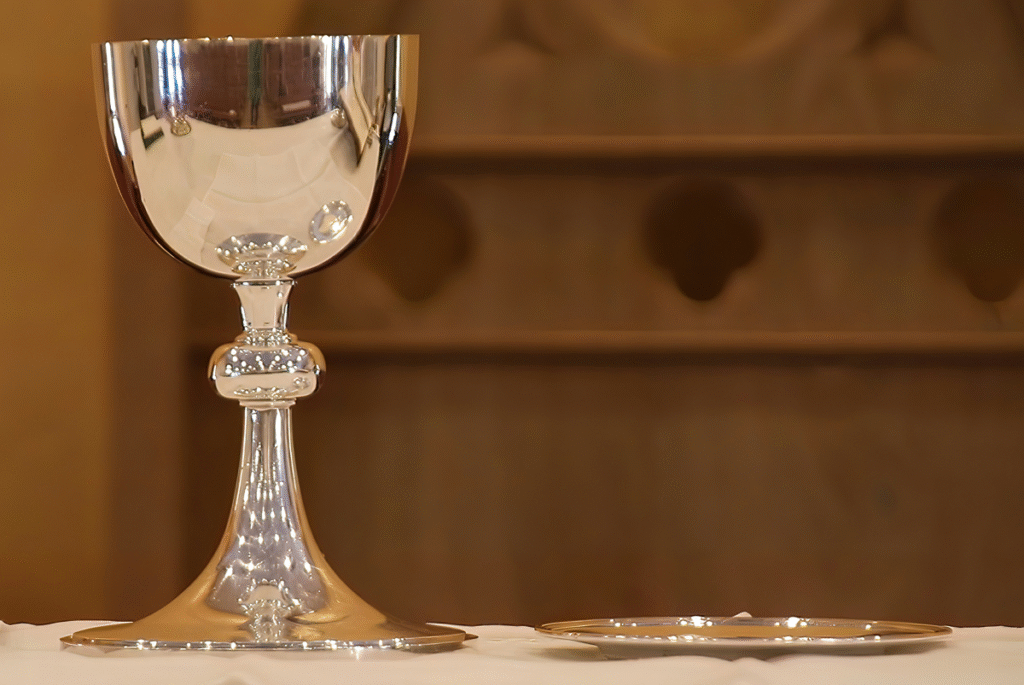
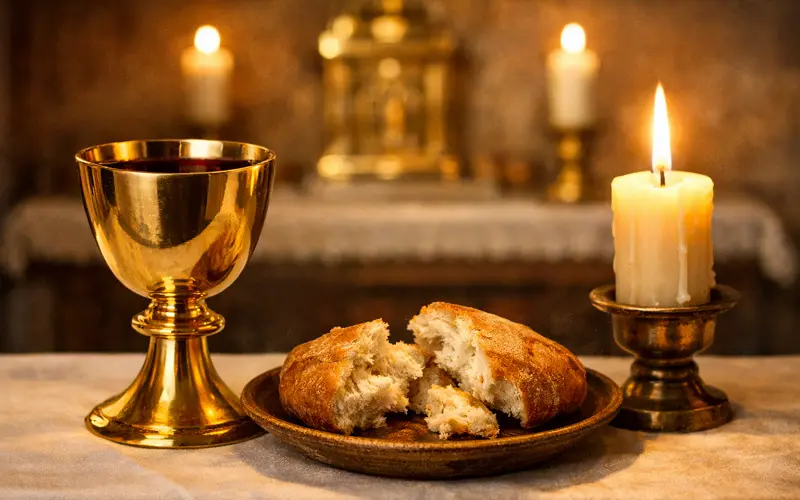
Taking bread in His hands, He said words no Jewish rabbi had ever said: “This is my Body, which will be given up for you.” Taking the cup of wine, He declared: “This is the chalice of my Blood — the Blood of the new and eternal covenant, which will be poured out for you and for many for the forgiveness of sins.”
In that moment, Jesus became the new Passover Lamb — not freeing Israel from Egypt, but freeing all humanity from sin and death. The old covenant made at Sinai was fulfilled and surpassed by a new and eternal covenant, sealed not in the blood of animals, but in His own.
This is why the Eucharist is not a symbol, a memorial, or a representation. It is the real presence of Jesus Christ — Body, Blood, Soul, and Divinity — given to us as the living bread that sustains the Church until the end of time.
The Washing of the Feet
Before the meal, Jesus did something that shocked His disciples.
He rose from the table, removed His outer garment, wrapped a towel around His waist, poured water into a basin, and began to wash His disciples’ feet.
This was the work of the lowest servant in a household. No one washed another person’s feet willingly — it was a task assigned to those with no social standing, no dignity to protect. And yet the Son of God knelt before twelve ordinary men and washed the dust of the road from their feet.
When He reached Peter, the apostle recoiled: “Lord, you will never wash my feet.” Jesus answered: “Unless I wash you, you have no part with me.”
What This Means for Us
The washing of the feet was not a lesson in etiquette. It was a revelation of the nature of God — and of what it means to follow Him.
Jesus was not simply modeling humility as a virtue. He was showing us that greatness in the Kingdom of God looks like service. That the one who wants to lead must first learn to kneel. That love, to be real, must cost something.
“I have given you an example,” He said when He finished, “so that as I have done for you, you should also do.”
On Holy Thursday, every Catholic is invited to ask: Who in my life needs me to kneel before them? Whose feet have I refused to wash?
The New Commandment
After washing their feet and returning to the table, Jesus gave His disciples what He called a new commandment:
“Love one another. As I have loved you, so you also should love one another. This is how all will know that you are my disciples — if you have love for one another.” (John 13:34–35)
The word “new” here is significant. The commandment to love your neighbor was not new — it was already present in the Old Testament. What was new was the standard: as I have loved you.
Not as you feel. Not as is convenient. Not as the other person deserves. But as Christ loved — completely, freely, to the point of laying down His life.
This is the definition of Christian love that Holy Thursday sets before us every year. It is impossibly high and absolutely non-negotiable. And it is only possible with His grace.
The Institution of the Priesthood
At the Last Supper, Jesus did not only give us the Eucharist — He gave us the means by which the Eucharist would continue to be offered until the end of time.
When He said “Do this in memory of me,” He was not addressing the entire Church. He was addressing His apostles — those He had chosen, called, and formed — commissioning them to continue His priestly work.
This is the origin of the ministerial priesthood in the Catholic Church. Every Mass celebrated in every church around the world is a participation in the one sacrifice of Calvary, made present through the hands of an ordained priest acting in persona Christi — in the person of Christ.
Holy Thursday is therefore also the feast of the priesthood. Many Catholics choose to pray especially for priests on this day — for their fidelity, their holiness, and their perseverance.
The Agony in the Garden
After the supper, Jesus led His disciples to the Garden of Gethsemane on the Mount of Olives. There, He asked Peter, James, and John to keep watch with Him — and there, alone in the darkness, He prayed.
“Father, if you are willing, take this cup from me — yet not my will, but yours be done.” (Luke 22:42)
The cup He spoke of was the full weight of human sin, suffering, and death — everything He was about to take upon Himself. His sweat became like drops of blood. An angel appeared to strengthen Him. And His disciples slept.
This moment — perhaps more than any other — reveals the full humanity of Jesus. He was afraid. He felt the weight of what was coming. He asked for another way. And then He chose obedience, chose love, chose us.
Shortly after, Judas arrived with soldiers. The arrest was made. And the Passion began.
The Mass of the Lord’s Supper
The evening Mass on Holy Thursday is one of the most beautiful and distinctive liturgies of the year. Several elements make it unlike any other Mass:
The Gloria
After weeks of silence during Lent, the Gloria is sung for the first time — and traditionally, the church bells ring out. It is a moment of joy in the middle of solemnity.
The Washing of the Feet
Following the homily, the priest washes the feet of twelve members of the congregation — men and women — re-enacting the gesture of Jesus. It is a moment of great tenderness and humility.
The Transfer of the Blessed Sacrament
At the end of Mass, the Blessed Sacrament is carried in solemn procession to a place of repose — an altar of adoration decorated with flowers and candles. This represents Jesus going to the Garden of Gethsemane.
The Stripping of the Altar
After the procession, the altar is stripped bare — all cloths, candles, and decorations are removed. The church is left empty and dark. It is one of the most striking visual moments of the entire liturgical year, representing the abandonment of Jesus.
The Night Watch
After Mass, the faithful are invited to remain and keep watch before the Blessed Sacrament — sometimes until midnight, sometimes through the night — in solidarity with Jesus in Gethsemane.
“Could you not keep watch with me for one hour?” (Matthew 26:40)
How to Live Holy Thursday
Attend the Mass of the Lord’s Supper
This evening Mass — usually at 7:00 or 8:00 PM — is the central celebration of the day. If at all possible, attend with your family.
Stay for Adoration
After Mass, remain for at least a short time before the Blessed Sacrament. Even fifteen or thirty minutes of quiet prayer in the presence of Jesus can change your Holy Week.
Pray for Priests
Holy Thursday is the feast of the priesthood. Pray for the priests in your life — those who have baptized you, absolved you, married you, anointed your loved ones. Their fidelity makes the sacraments possible.
Read John 13–17
These five chapters of John’s Gospel — the “Farewell Discourse” — contain everything Jesus said at the Last Supper. They are among the most beautiful and intimate words in all of Scripture. Read them slowly on Holy Thursday evening.
Examine Your Love
Before the end of the day, ask yourself honestly: How am I loving? Am I loving as He loved — or only as is comfortable? Let the New Commandment land in your heart tonight.
Prayer for Holy Thursday
In the name of the Father, and of the Son, and of the Holy Spirit. Amen.
Lord Jesus Christ, tonight I return to the upper room with You. I take my place at the table — not because I am worthy, but because You invited me.
You took bread into Your hands — the same hands that shaped the mountains, that healed the blind, that would be pierced by nails before morning — and You said: This is my Body, given for you.
Lord, I believe. Help my unbelief. Let me never receive You casually, never forget what this gift cost You, never take for granted the miracle that happens at every altar, every day, in every corner of the world.
You knelt before Your disciples and washed their feet — even the feet of the one who would betray You, even the feet of the one who would deny You.
Teach me that kind of love. The love that kneels. The love that serves without keeping score. The love that washes the feet of those who have hurt me, disappointed me, abandoned me.
I cannot love like that on my own. Give me Your love, Lord. Let it flow through me to others.
You gave us a new commandment: Love one another as I have loved you.
Tonight I confess how far I fall short of that standard. The love I withhold. The patience I refuse. The mercy I demand for myself and deny to others.
Forgive me. And begin again in me.
In the garden, You were afraid. You asked for another way. And then You said yes — yes to the Father, yes to the cross, yes to me.
When I face my own Gethsemanes — the moments when faithfulness costs everything — give me the grace of Your surrender. Not my will, but Yours.
Lord, keep me awake tonight. Do not let me be like the disciples who slept while You prayed alone in the darkness.
Keep watch with me. Or rather — let me keep watch with You.
This one hour. This one week. This one life.
In the name of the Father, and of the Son, and of the Holy Spirit. Amen.
Frequently Asked Questions About Holy Thursday
Holy Thursday is not a holy day of obligation, but Catholics are strongly encouraged to attend the Mass of the Lord’s Supper. It is one of the most significant liturgies of the year.
Yes. Abstinence from meat is required only on Good Friday and the Fridays of Lent — not on Holy Thursday.
The word “Maundy” comes from the Latin mandatum — commandment. It refers to the new commandment Jesus gave at the Last Supper: “Love one another as I have loved you.”
The Mass of the Lord’s Supper is traditionally celebrated in the evening — most parishes offer it at 7:00 PM or 7:30 PM. Check with your local parish for exact times.
The bells ring at the Gloria on Holy Thursday as a sign of joy — and then fall silent until the Easter Vigil. This silence represents the mourning of the Church during the Passion and death of Christ.
Related Prayers and Resources
- ⭐ Palm Sunday Prayer 2026 — Begin Holy Week with the triumphant entry of Christ
- ⭐ Stations of the Cross Prayer — Walk the Way of the Cross on Good Friday
- ⭐ Good Friday 2026 — Stand at the foot of the Cross
- ⭐ Divine Mercy Novena — Begin on Good Friday, conclude on Divine Mercy Sunday
- ⭐ Holy Week 2026 Complete Guide — Every day of Holy Week explained
Save this reflection for Holy Thursday / Share it with your family