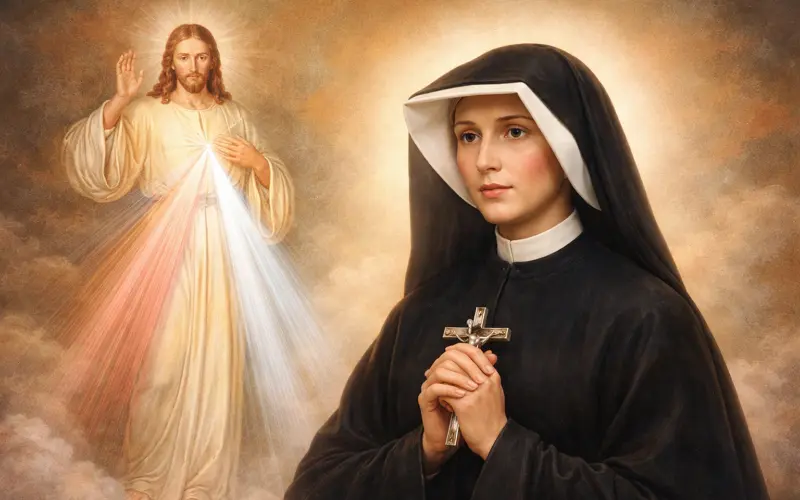
She was a poor, uneducated nun from rural Poland. She never wrote a book, never traveled the world, never held a position of influence. And yet the message Jesus entrusted to her has reached millions of souls across every continent — people who pray “Jesus, I trust in You” in hospital rooms, in prisons, in moments of despair. This is the story of Saint Faustina Kowalska, the secretary of Divine Mercy.
Historical and Theological Context
Helena Kowalska was born on August 25, 1905, in Glogowiec, a small village in central Poland — the third of ten children in a deeply poor but devout family. From childhood she felt drawn to religious life, but her parents could not afford the dowry required to enter a convent. She worked as a housekeeper for years, saving quietly, until she was finally accepted into the Congregation of the Sisters of Our Lady of Mercy in Warsaw in 1925. She took the name Maria Faustina.
By every external measure, her life was unremarkable. She cooked, cleaned, gardened, and worked the door of the convent. She was not a scholar or a preacher. But beginning in 1931, she began receiving visions of Jesus — visions so vivid, so specific, so theologically coherent, that her spiritual directors eventually instructed her to write them down.
The result was her Diary — over 600 pages of mystical experience, spiritual insight, and direct conversations with Jesus. It remains one of the most widely read spiritual documents of the twentieth century, translated into dozens of languages and studied by theologians around the world.
What Saint Faustina Means for Catholics Today
Faustina was not chosen because she was extraordinary. She was chosen because she was willing. That is the first and most important thing her life teaches us.
Her life also teaches us something about suffering. She was chronically ill with tuberculosis for most of her religious life, often misunderstood by her superiors, and at times doubted even by her confessors. She carried her mission in silence and obedience — not because it was easy, but because she trusted.
For those who are suffering today — from illness, from loneliness, from a sense that God has forgotten them — Faustina is a companion who has walked that road. She did not receive easy consolations. She received a cross, and she carried it with trust.
She died on October 5, 1938, at just 33 years old — the same age as Jesus at His death. She was canonized by Pope John Paul II on April 30, 2000, the first Divine Mercy Sunday of the new millennium. Her feast day is October 5.
The Message She Carried
Jesus gave Faustina three specific tasks — three ways to spread the message of Divine Mercy to the world:
- The Image — Jesus appeared to her with two rays of light flowing from His heart, one red and one white, representing the blood and water that flowed from His side on Calvary. He asked that this image be venerated, with the words “Jesus, I trust in You” written beneath it.
- The Feast — He asked for a feast of Divine Mercy to be established on the Second Sunday of Easter, with the promise of complete forgiveness of sins and punishment for those who receive Confession and Communion on that day.
- The Chaplet — He taught her a simple prayer to be prayed on rosary beads, offering His body, blood, soul, and divinity to the Father for the forgiveness of sins. He attached extraordinary promises to this prayer, especially for the dying.
Each of these gifts is available to us today — not as historical artifacts, but as living channels of grace that Faustina obtained for the Church through her suffering and trust.
Practical Ways to Honor Saint Faustina
- Read a passage from her Diary — even one page a day. It is available online and in print. Her words are remarkably accessible, written from the heart of a simple woman who loved God deeply.
- Pray the Chaplet of Divine Mercy daily, especially at 3:00 PM — the Hour of Mercy that Jesus specifically requested through Faustina.
- Keep or display the image of Divine Mercy in your home. Faustina understood it not as a decoration but as a reminder of God’s constant mercy toward us.
- Celebrate her feast day on October 5 with Confession and a prayer of thanksgiving for the gift of Divine Mercy.
- When you are suffering and feel unheard — ask for her intercession. She knows what it is to carry a mission in silence, to be doubted, to be sick, and to trust anyway.
Words of Saint Faustina
“O my Jesus, despite the deep night that is all around me and the dark clouds which hide the horizon, I know that the sun never goes out.” — Diary §73
“The greater the sinner, the greater the right he has to My mercy.” — Jesus to Saint Faustina, Diary §723
“I have opened My Heart as a living fountain of mercy. Let all souls draw life from it. Let them approach this sea of mercy with great trust.” — Jesus to Saint Faustina, Diary §1520
A Prayer Through the Intercession of Saint Faustina
Ask her to bring your needs before the throne of mercy — she knows the way.
Saint Faustina,
you who carried the message of mercy in times of doubt and silence,
intercede for me before the Heart of Jesus.
You know what it is to suffer in silence,
to trust when everything feels dark.
Teach me to trust as you trusted.
And bring before Jesus the intention I carry in my heart, known only to God,
Jesus, I trust in You.
Amen.
Related Articles
- What Is Divine Mercy? — The complete guide to this devotion
- Divine Mercy Sunday 2026 — The feast Faustina was asked to establish
- Divine Mercy Novena — Begin on Good Friday, April 3
- Chaplet of Divine Mercy — The prayer Jesus taught Saint Faustina
- The Hour of Mercy — Why 3:00 PM is sacred in this devotion