There are moments in life when guilt feels heavier than anything we can carry. When we wonder if what we have done — or failed to do — is truly forgivable. Divine Mercy is God’s answer to that question. It is not just a devotion among many. It is one of the most profound revelations Jesus gave to the modern world: that His mercy is greater than any sin, and that He is waiting for us to trust Him.
Divine Mercy is the Catholic devotion that reveals the depth of God’s love and forgiveness toward every soul.
The Origin of the Divine Mercy Devotion
The devotion to Divine Mercy as we know it today has its roots in 1930s Poland, through the mystical experiences of a young nun named Sister Faustina Kowalska. Between 1931 and 1938, she recorded thousands of pages of visions and inner locutions in what became known as the Diary of Saint Maria Faustina Kowalska — one of the most remarkable spiritual documents of the twentieth century.
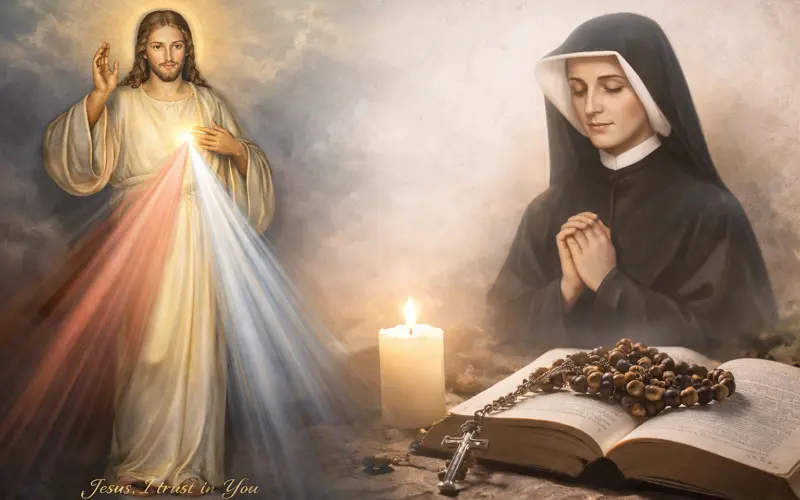
In her diary, Faustina wrote that Jesus appeared to her and revealed His merciful heart, asking her to spread this message to a world torn by war and despair. He gave her the image of the Divine Mercy — the rays of red and white light flowing from His heart — and asked for the Chaplet of Divine Mercy to be prayed daily.
At first, the devotion faced resistance. But in 2000, Pope John Paul II — himself a Polish pope who had lived through the same darkness Faustina prayed against — officially canonized her and established Divine Mercy Sunday as a universal feast of the Catholic Church, celebrated on the Second Sunday of Easter, entrusting this message to the whole world.
Many Catholics pray a Divine Mercy prayer for urgent help in difficult times.
What Divine Mercy Means for Catholics Today
Divine Mercy is not just a devotion. It is a way of seeing God — and a way of seeing ourselves in relation to Him. Three truths are at its heart:
- God’s mercy is infinite and unconditional. No sin is greater than His desire to forgive. As Jesus told Faustina: “The greater the sinner, the greater the right he has to My mercy.”
- Trust is the key. Divine Mercy is not received passively — it requires an act of trust. “Jesus, I trust in You” is not merely a phrase. It is a surrender, a choice to believe that God’s love is stronger than our failures.
- Mercy received must become mercy given. Jesus asked Faustina not only to receive His mercy but to practice it — through deed, word, and prayer. We are called to be instruments of His mercy to others.
The image of Divine Mercy — Jesus with two rays flowing from His heart, one red and one white — represents the blood and water that flowed from His side on the Cross. Beneath the image, the words: “Jesus, I trust in You.” Many Catholic families keep this image in their homes as a reminder of this promise.
Practical Ways to Live Divine Mercy
Divine Mercy is meant to be lived, not just admired. Here are concrete ways to make it part of your daily faith:
- Pray the Chaplet of Divine Mercy daily, especially at 3:00 PM — the Hour of Mercy, when Jesus died on the Cross.
- Receive the Sacrament of Confession and Holy Communion on Divine Mercy Sunday (April 12, 2026). Jesus promised complete forgiveness of sins and punishment to those who do this with trust.
- Pray the Divine Mercy Novena, which begins on Good Friday (April 3, 2026) and ends on the eve of Divine Mercy Sunday.
- Forgive someone you have been holding resentment against — a kind word, a forgiving heart, a prayer for someone who has hurt you.
- Venerate the image of Divine Mercy in your home, and teach your children to say “Jesus, I trust in You” — especially in moments of fear or failure.
Scripture and Saint Quotes
“His mercy endures forever.” — Psalm 136
“Be merciful, just as your Father is merciful.” — Luke 6:36
“The greater the sinner, the greater the right he has to My mercy.” — Jesus to Saint Faustina, Diary §723
“I desire that the Feast of Mercy be a refuge and shelter for all souls, and especially for poor sinners.” — Jesus to Saint Faustina, Diary §699
A Short Prayer of Divine Mercy
If you have never prayed to the Divine Mercy before, start here. You don’t need special words. You only need a willing heart.
Lord Jesus,
I come before You not because I am worthy,
but because You told me to come.
I bring You my failures, my fears, and everything I am ashamed of.
I trust that Your mercy is greater than all of it.
Wash me clean. Hold me close. Let me begin again.
Jesus, I trust in You.
Amen.
If your heart is searching for mercy, don’t stop here.
Continue with the Divine Mercy Novena — a nine-day journey of trust that begins on Good Friday.
Divine Mercy Sunday opens the Easter season that leads us to Pentecost — the feast of the Holy Spirit. Discover: Pentecost 2026 — Meaning, Date, and How to Celebrate.
Continue Your Divine Mercy Devotion
Now that you’ve learned about the message of Divine Mercy, continue your journey through these prayers and devotions.
- Divine Mercy — Discover the heart of the Divine Mercy devotion and explore its prayers, feast, and message of hope.
- Divine Mercy Chaplet — Pray the Chaplet Jesus entrusted to Saint Faustina and place yourself in His infinite mercy.
- Saint Faustina Kowalska — Meet the humble Polish nun chosen to share Christ’s message of Divine Mercy with the world.
- Divine Mercy Image — Discover the history and meaning of the image bearing the words “Jesus, I trust in You.”