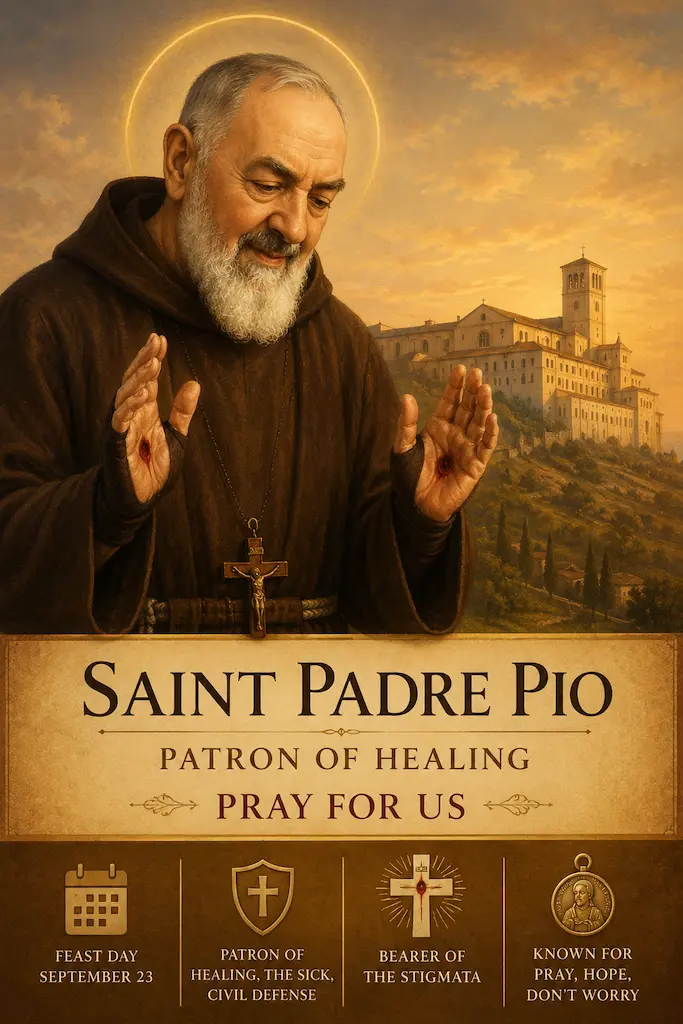
📅 Feast Day: September 23
🛡️ Patron of: Civil defense volunteers, adolescents, stress relief
🙏 Invoked for: Healing, peace, and spiritual strength
✝️ Born: May 25, 1887, Pietrelcina, Italy
☩ Died: September 23, 1968, San Giovanni Rotondo
🏅 Known for: Bearing the stigmata for fifty years
🏛️ Religious Order: Order of Friars Minor Capuchin
From Pietrelcina to the Wounds of Christ: the Stigmata of Padre Pio
Francesco Forgione was born on May 25, 1887, in the small southern Italian town of Pietrelcina. From childhood, he experienced mystical visions of Jesus and Mary — the first signs of a spiritual depth that would mark his entire life. At fifteen, he joined the Capuchin Franciscan order, taking the name “Pio” in honor of Pope Saint Pius I.
On September 20, 1918, while praying before a crucifix at the Capuchin friary in San Giovanni Rotondo, Padre Pio received the stigmata — the five wounds of Christ, piercing his hands, feet, and side. For the next fifty years, until his death, these wounds remained a visible sign of his participation in the Passion of Christ. Doctors who examined them could offer no medical explanation: the wounds never became infected, never scarred, and pilgrims often reported a mysterious fragrance of flowers around them.
A Life of Suffering, Obedience, and Extraordinary Gifts
Padre Pio’s life was marked by supernatural gifts that drew both devotion and suspicion. He was known for bilocation — appearing in two places at once to comfort the dying or protect someone in danger. In the confessional, he seemed to read souls, naming sins before they were spoken. He prophesied future events, and endured violent nights of demonic attack that left visible marks on his body.
Yet holiness did not spare him from suffering within the Church itself. For years, ecclesiastical authorities — doubting the authenticity of his wounds — forbade him from celebrating public Mass or hearing confessions. He accepted these restrictions in obedience, even though being separated from the altar and the confessional caused him deep suffering. For Padre Pio, the celebration of Mass and the sacrament of Reconciliation were at the heart of his priestly ministry. He had spent countless hours hearing confessions and bringing souls back to God’s mercy, and being unable to serve the faithful in this way was one of the great trials of his life.
His daily life was demanding beyond ordinary limits: up to nineteen hours in the confessional, and a celebration of Mass so absorbed in Christ’s Passion that witnesses described him in tears, as though reliving Calvary itself.
Casa Sollievo della Sofferenza — A Legacy of Healing
In 1956, Padre Pio founded Casa Sollievo della Sofferenza — the Home for the Relief of Suffering — a hospital built in San Giovanni Rotondo that continues to serve the sick to this day. It was, in many ways, his suffering made visible in service to others: a place where physical healing and spiritual care were meant to walk hand in hand.
Millions of pilgrims traveled to this remote monastery to attend his Mass, seek his blessing, or confess before him. What they carried home was not only comfort, but a phrase that has since become one of the most quoted in Catholic spirituality: “Pray, hope, and don’t worry. Worry is useless.”
Death and Canonization
Padre Pio died on September 23, 1968, at the age of 81. His final words were simple: “Jesus, Mary. Jesus, Mary.” More than 100,000 people attended his funeral. Pope John Paul II beatified him in 1999 and canonized him on June 16, 2002, calling him “a true image of Christ crucified and a living icon of the suffering Christ.”
More than half a century after his death, Padre Pio continues to remind us that suffering, when united to Christ, is never wasted — and that even the most impossible situations remain within reach of God’s mercy.
Continue Your Journey with Padre Pio
- Novena to Padre Pio — nine days of prayer leading to his feast day
- Prayer to Padre Pio for Healing — for physical, emotional, or spiritual healing
- Prayer to Padre Pio for Impossible Causes — when every door seems closed
Frequently Asked Questions
Padre Pio (1887–1968), born Francesco Forgione, was an Italian Capuchin friar who bore the stigmata — the visible wounds of Christ — for fifty years. He is one of the most beloved saints of the modern era, invoked for healing, impossible causes, and spiritual strength.
On September 20, 1918, Padre Pio received the stigmata — wounds corresponding to those of Christ’s crucifixion — which he bore visibly for fifty years. Medical examinations could not explain why the wounds never became infected or scarred.
“Padre Pio” was his name as a friar and became so widely used during his lifetime that popular devotion still calls him this way, even though his official canonized title is Saint Pius of Pietrelcina.
The feast day of Padre Pio is celebrated on September 23, the anniversary of his death in 1968. He was canonized by Pope John Paul II on June 16, 2002.
Padre Pio is famous for his deep devotion to Christ, his ministry as a Capuchin priest and confessor, the stigmata he bore for many years, his reported extraordinary spiritual gifts, and his service to the sick through Casa Sollievo della Sofferenza. He was canonized by Pope John Paul II in 2002.