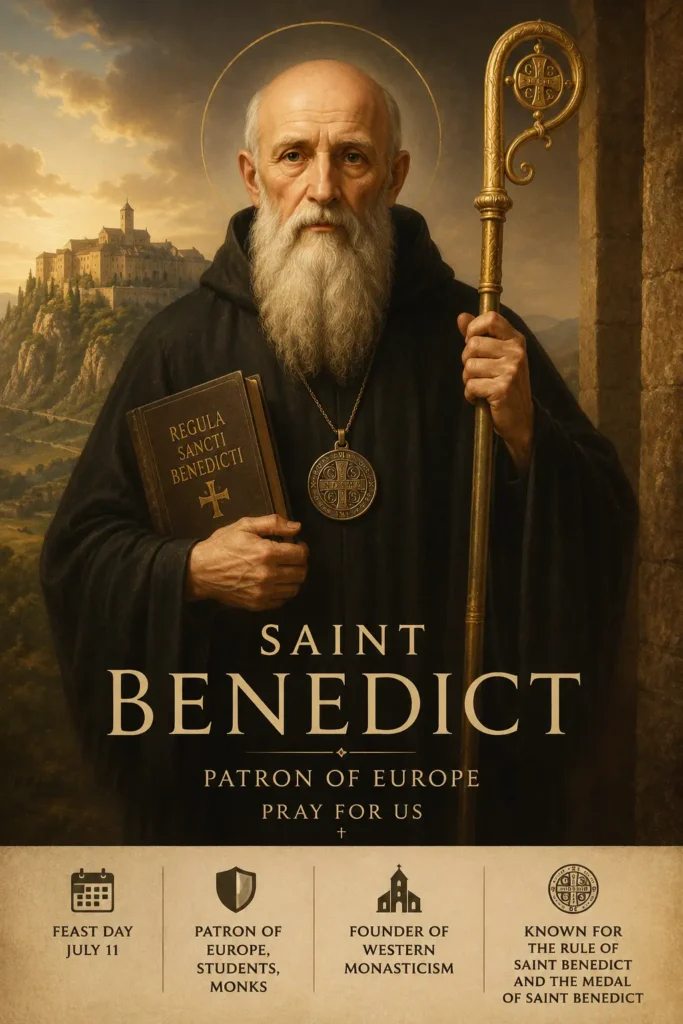
📅 Feast Day: July 11
🛡️ Patron of: Europe, students, monks
✝️ Born: c. 480 AD, Norcia, Italy
☩ Died: c. 547 AD, Monte Cassino
🏅 Known for: The Rule of Saint Benedict
and the Medal of Saint Benedict
🏛️ Religious Order: Order of Saint Benedict
From Rome to the Cave of Subiaco — The Early Life of Saint Benedict
Benedict of Nursia was born around 480 AD in the town of Norcia, in the Umbria region of central Italy, into a noble Roman family. As a young man, his family sent him to Rome to study rhetoric and law — the typical path for someone of his social standing. But what he found in Rome disturbed him deeply. The city was morally chaotic, the students dissolute, and the academic culture hollow. Benedict walked away from all of it. He sought not isolation for its own sake, but a life ordered entirely toward God.
He left Rome with his nurse and settled first in the village of Enfide, in the Sabine hills. But even there, word of a small miracle — he had mended a broken clay sieve through prayer — brought him more attention than he wanted. He slipped away alone, deeper into the mountains, until he found a narrow cave above a lake near Subiaco. There, with the help of a monk named Romanus who lowered bread to him daily on a rope, Benedict spent three years in solitude, prayer, and fasting.
He was not yet thirty years old. And from that cave, the transformation of Western Christianity would begin.
The Founder of Monasticism — Monte Cassino and the Rule
Word of Benedict’s holiness spread despite his desire for solitude. Twice, communities of monks invited him to lead them — and twice he warned them he would be too strict. The second community, frustrated with his discipline, attempted to poison his wine. According to tradition, when Benedict made the Sign of the Cross over the cup, it shattered. He left them without anger and returned to his cave.
But disciples came to him — sincere ones this time. He organized them into twelve small monasteries of twelve monks each. Around 529 AD, he left Subiaco and founded the great monastery of Monte Cassino, on a mountain overlooking the road between Rome and Naples. It was there that he wrote the document that would shape Christian civilization for the next fifteen centuries: the Rule of Saint Benedict.
The Rule is deceptively simple. It organizes the monastic day around prayer, work, and community. Its spirit is often summarized by the phrase Ora et Labora — “Pray and Work.” It is firm but humane, demanding but compassionate. Pope Benedict XVI called it one of the most decisive texts in the history of Europe. It remains the living guide of thousands of Benedictine monks and nuns to this day.
The Medal of Saint Benedict — A Sign of Protection
Among the most widely used sacramentals in the Catholic world, the Medal of Saint Benedict carries centuries of history and devotion. Its origins trace back to an episode from Benedict’s own life: when enemies twice attempted to poison him — first through wine, then through bread — both attempts failed through the power of prayer and the Sign of the Cross.
The medal bears a cross with the initials CSPB — Crux Sancti Patris Benedicti, the Cross of the Holy Father Benedict — surrounded by a Latin exorcism prayer. It was officially approved by Pope Benedict XIV in 1742 and has been used ever since as a sign of protection against evil, illness, and temptation.
Today the Medal of Saint Benedict is worn by millions of the faithful, placed in homes, buried in the foundations of buildings, and given to the sick. It is not magic — it is a prayer in metal form, an act of trust in the God who protected Benedict in his cave, at his table, and at his death.
The Death of Saint Benedict and His Legacy
Benedict’s twin sister, Saint Scholastica, had consecrated her life to God and lived nearby as the head of a community of women. According to Pope Gregory the Great — who wrote the only surviving biography of Benedict — the two met once a year to pray and discuss spiritual matters. When Scholastica died, Benedict saw her soul rise to heaven in the form of a dove. He died just days later, around 547 AD, standing upright in prayer, supported by his monks. According to tradition, he received the Holy Eucharist before peacefully surrendering his soul to God.
He was declared Patron Saint of Europe by Pope Paul VI in 1964, in recognition of the extraordinary role that Benedictine monasticism played in preserving learning, faith, and civilization during the darkest centuries of European history. In 1980, Pope John Paul II added Saints Cyril and Methodius as co-patrons alongside him.
His feast day is celebrated on July 11 by the universal Roman Church.
More than fifteen centuries after his death, Saint Benedict continues to remind us that holiness is built one faithful day at a time. His life teaches that prayer, work, humility, and perseverance can transform not only a single soul but entire civilizations. Whether we seek protection through the Medal of Saint Benedict, pray his novena, or simply strive to live with greater fidelity, his witness continues to point us toward Christ.
Continue Your Journey with Saint Benedict
- 🙏 Novena to Saint Benedict — Begin July 2, feast day July 11
- 📿 Prayer to Saint Benedict — coming soon
- 🛡️ The Medal of Saint Benedict — one of the most powerful sacramentals in the Church
- 📖 The Rule of Saint Benedict — still guiding communities fifteen centuries later
- 🎉 Celebrate His Feast Day
Frequently Asked Questions
Saint Benedict (c. 480–547 AD) was the founder of Western monasticism and the author of the Rule of Saint Benedict. He is the patron saint of Europe, students, and monks, and is remembered for his lasting influence on Christian spirituality and monastic life.
The Rule of Saint Benedict is a document written by Saint Benedict around 529 AD to guide the life of his monastic community. Built on the principle of Ora et Labora — Pray and Work — it organizes the day around prayer, work, and community life. It remains the foundational document of Benedictine monasticism and has shaped Christian life in the West for fifteen centuries.
The Medal of Saint Benedict is one of the most widely used Catholic sacramentals. It bears a cross and inscriptions forming a Latin exorcism prayer attributed to Saint Benedict. It was officially approved by Pope Benedict XIV in 1742 and is worn or placed in homes as a sign of protection against evil and temptation.
The feast day of Saint Benedict is celebrated on July 11 in the universal Roman Calendar. Benedictine communities also celebrate March 21, the traditional date of his death.