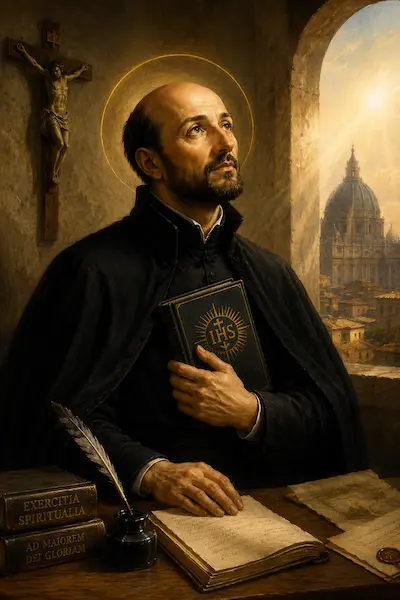
He was not born a saint. He was born ambitious — hungry for glory, for recognition, for the kind of greatness that the world notices. And then a cannonball shattered his leg on a battlefield in Pamplona, and in the long silence of recovery, something else began. He picked up a book about the life of Christ. And then another, about the saints. And slowly, painfully, the old desires began to loosen their grip. Saint Ignatius of Loyola did not find God in a moment of triumph. He found Him in weakness, in stillness, in the slow work of grace on a soul that had wanted everything except what mattered most. If you are searching for God’s will — in a decision, in a vocation, in a life that has not gone the way you planned — pray this novena with him.
Historical Context — From Soldier to Saint
Ignatius of Loyola was born in 1491 in the Basque region of Spain into a noble family. Ambitious and restless, he pursued a military career until 1521, when a cannonball at the Battle of Pamplona shattered his right leg and ended his active service. During a long and painful convalescence at the castle of Loyola, he read the only books available to him — a life of Christ and a collection of saints’ lives. Those books changed everything.
After his recovery, he spent nearly a year in prayer and penance in a cave near Manresa, Spain, where he began writing what would become the Spiritual Exercises — one of the most influential works in the history of Catholic spirituality. He later studied in Paris, where he gathered six companions around him. In 1534, they took vows together at Montmartre. In 1540, Pope Paul III officially recognized the Society of Jesus — the Jesuits.
Ignatius served as the first Superior General of the Jesuits until his death on July 31, 1556. He was canonized on March 12, 1622. His feast day is July 31.
A Documented Conversion — The Cave of Manresa
The months Ignatius spent in a cave near Manresa, Spain, between 1522 and 1523, are among the most documented spiritual conversions in Catholic history. He fasted severely, prayed for hours, and experienced both profound consolations and devastating desolations. He later described an illumination he received while sitting on the banks of the Cardoner River — a sudden, overwhelming understanding of spiritual things that he said taught him more than all his years of study combined.
It was in Manresa that the Spiritual Exercises took shape — a structured method of prayer and discernment designed to help a soul find God’s will and make a total offering of itself to God. Pope Paul III approved the Exercises in 1548. They have since been used by millions of Catholics around the world, including popes, bishops, and countless ordinary faithful seeking to know and do God’s will.
The Suscipe — the great prayer of surrender found in the Spiritual Exercises — beautifully expresses the spirituality that took shape during this period:
“Take, Lord, and receive all my liberty, my memory, my understanding, and my entire will. Whatever I have or hold, you have given to me; I restore it all to you and surrender it wholly to be governed by your will. Give me only your love and your grace, and I am rich enough and ask for nothing more.”
Why Pray This Novena?
- When you are facing a major decision and need discernment
- When you feel restless and cannot find peace
- For students, teachers, and those in education
- For soldiers and those in military service
- When you want to surrender your will to God’s will
- For those on spiritual retreat or deepening their prayer life
- When you need courage to follow God’s call without compromise
- On his feast day, July 31
How to Pray the Novena
Begin on July 22 to finish on July 30, the eve of his feast day.
Each day:
- Begin with the Sign of the Cross
- Pray the Suscipe — the prayer of Saint Ignatius
- Pray the Anima Christi — the Soul of Christ prayer
- Mention your personal intention
- Spend a few moments in silent prayer, asking God for the grace of discernment.
- Close with one Our Father, one Hail Mary, and one Glory Be
You may pray this novena at any time of year for discernment, guidance, or spiritual renewal.
Novena Prayers
Day 1 through Day 9 — pray the same prayers each day:
The Suscipe — Prayer of Saint Ignatius
Take, Lord, and receive all my liberty,
my memory, my understanding,
and my entire will.
All I have and call my own.
You have given all to me.
To you, Lord, I return it.
Everything is yours; do with it what you will.
Give me only your love and your grace,
that is enough for me.
Amen.
The Prayer for Generosity (Traditionally Attributed to Saint Ignatius)
Dearest Lord,
teach me to be generous.
Teach me to serve you as you deserve;
to give and not to count the cost,
to fight and not to heed the wounds,
to toil and not to seek for rest,
to labor and not to ask for any reward,
save that of knowing that I do your will.
Amen.
Anima Christi
Soul of Christ, sanctify me.
Body of Christ, save me.
Blood of Christ, inebriate me.
Water from the side of Christ, wash me.
Passion of Christ, strengthen me.
O Good Jesus, hear me.
Within your wounds shelter me.
Do not let me be separated from you.
From the evil one, protect me.
At the hour of my death, call me.
And bid me come to you,
that with your saints I may praise you
forever and ever.
Amen.
Saint Ignatius of Loyola, pray for us.
(Conclude each day with one Our Father, one Hail Mary, one Glory Be.)
About Saint Ignatius of Loyola
Saint Ignatius of Loyola (1491–1556) was a Spanish Basque priest, theologian, and mystic who founded the Society of Jesus (Jesuits) in 1540. Known for his Spiritual Exercises and his motto Ad Maiorem Dei Gloriam — “For the greater glory of God” — he taught that holiness is not reserved for monasteries but is possible in the midst of ordinary life, work, and engagement with the world. He is the patron saint of soldiers, educators, and spiritual retreats.
Related Devotions
- Prayer to Saint Ignatius of Loyola
- Prayer for Courage to Begin Again
- Catholic Prayer for Impossible Situations
- Novena to Saint Benedict
Frequently Asked Questions
Begin the novena on July 22 to finish on July 30, the eve of his feast day on July 31. You can also pray it at any time of year when you need discernment, guidance, or the courage to follow God’s will.
The Spiritual Exercises are a structured program of prayer, meditation, and discernment written by Saint Ignatius of Loyola. Designed to be completed over four weeks, they help people discern God’s will and offer themselves more completely to God. They were approved by Pope Paul III in 1548 and remain one of the most influential works in Catholic spirituality.
The Suscipe is a prayer of total surrender found in the Spiritual Exercises of Saint Ignatius of Loyola. It begins: “Take, Lord, and receive all my liberty, my memory, my understanding, and my entire will.” It is one of the best-known prayers of the Ignatian tradition and is prayed daily by Jesuits and many other Catholics.
Saint Ignatius of Loyola is the patron saint of soldiers, educators, and spiritual retreats. He is also the patron of the Society of Jesus (Jesuits), the religious order he founded in 1540.