The Miraculous Medal is one of the most beloved sacramentals in the Catholic Church.
For almost 200 years, countless Catholics have worn it as a sign of trust in the Blessed Virgin Mary — and many testify to extraordinary graces, conversions, and protections.
But why should a Catholic wear the Miraculous Medal today?
What does it mean?
What graces did Our Lady promise?
And how do we wear it properly?
Below is a complete guide to help you understand the history, meaning, and spiritual power of this beautiful devotion. 💙✨
What Is the Miraculous Medal?
The Miraculous Medal is a sacramental given to the Church through Saint Catherine Labouré following the Marian apparitions she reported in Paris in 1830.
During the November 27 apparition, Our Lady asked that a medal be struck according to the image Catherine had seen and said:
“All who wear it will receive great graces; they should wear it around the neck. Graces will abound for persons who wear it with confidence.”
The medal was first known as the Medal of the Immaculate Conception. As reports of favors, conversions, and other graces associated with its use spread among the faithful, it became known as the Miraculous Medal.
A Brief History: The Apparitions to St. Catherine Labouré
- Date: July 19–20 and November 27, 1830
- Place: Motherhouse of the Daughters of Charity, Rue du Bac, Paris
- Recipient: Catherine Labouré, a humble 24-year-old novice
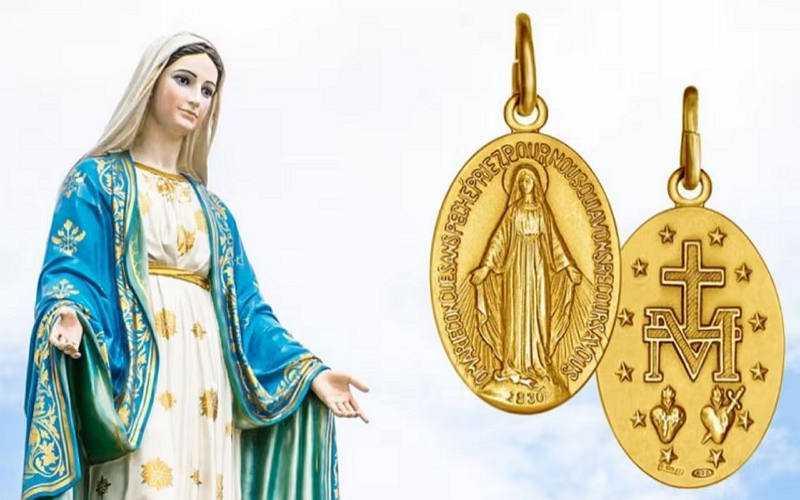
During the apparitions, Our Lady appeared standing on a globe with rays of light streaming from her hands — symbolizing graces poured upon the world.
She requested a medal to be struck with the exact design she revealed.
On the medal, she instructed:
- Front: Mary standing on a globe, crushing the serpent
- Words: O Mary conceived without sin, pray for us who have recourse to thee
- Back: Cross and bar, the letter “M,” the Sacred Heart, the Immaculate Heart, and twelve stars
The imagery expresses Mary’s role in salvation history and her maternal intercession for souls.
Meaning of the Symbols on the Miraculous Medal
Mary Crushing the Serpent
Represents her victory — through Christ — over sin and Satan.
Rays of Light From Her Hands
Graces she obtains for those who ask with faith.
The Inscription
A prayer of trust in her immaculate purity and maternal intercession.
The “M” and the Cross
The unique union between Jesus and Mary in the work of redemption.
The Two Hearts
The Sacred Heart of Jesus (crowned with thorns)
and the Immaculate Heart of Mary (pierced with a sword).
Twelve Stars
The Church, the apostles, and Mary crowned as Queen of Heaven.
Promises Associated With the Medal
The promise associated with the Miraculous Medal is the promise of great graces for those who wear it, especially with confidence.
The medal is not a guarantee of a particular earthly outcome or a promise that every difficulty will disappear. Rather, its use is meant to turn our hearts toward God through the maternal intercession of the Blessed Virgin Mary.
Among the graces Catholics have traditionally associated with this devotion are:
- Deeper faith
- Conversion
- Strength in suffering
- Peace of heart
- Perseverance in prayer
- A return to the sacraments
- Greater trust in God
- Final perseverance
These graces should not be understood as automatic results produced by the medal itself. The Miraculous Medal is a sacramental, not a magical object. Its purpose is to dispose us to receive grace, strengthen our devotion, and remind us to turn to God with faith and confidence.
A Documented Miracle: The Conversion of Alphonse Ratisbonne
Not every grace tied to the Miraculous Medal is anecdotal.
One conversion is so well documented that the Church herself opened a formal inquiry into it — and the chapel where it happened is still a shrine today.
Alphonse Ratisbonne was born in Strasbourg in 1814, the youngest son of a prominent Jewish banking family. His older brother Theodore had converted to Catholicism and become a priest years earlier — a wound the family never fully accepted. Alphonse grew into a young man with an open hostility toward the Catholic faith.
In January 1842, while in Rome, Alphonse befriended Baron Théodore de Bussières, a Catholic convert. Half out of curiosity, half to humor his friend, Alphonse agreed to wear a Miraculous Medal and recite the Memorare daily — convinced it would change nothing.
On January 20, while waiting inside the church of Sant’Andrea delle Fratte for the Baron, Alphonse was suddenly overtaken by an inexplicable unease. He looked up — and, by his own sworn testimony, saw the church around him fall into shadow except for one side chapel, filled with light. There, above the altar, stood the Virgin Mary, exactly as she appears on the Miraculous Medal.
She said nothing. She did not need to. Alphonse fell to his knees, and when the Baron found him minutes later, he could barely speak — only kissing the medal and repeating, “I have seen her. I have seen her.”
The news of the conversion spread quickly through Rome. Pope Gregory XVI ordered a canonical examination of the circumstances surrounding it. Under the authority of Cardinal Costantino Patrizi, Vicar General of Rome, nine witnesses were formally examined. On June 3, 1842, Cardinal Patrizi declared the instantaneous and complete conversion of Alphonse Ratisbonne a true miracle attributed to the intercession of the Blessed Virgin Mary.
Alphonse was baptized, took the name Marie-Alphonse, and was ordained a priest in 1847. Together with his brother Theodore, he founded a religious congregation devoted to fostering understanding between Jews and Christians — the very people he had once refused to acknowledge as his own.
The side chapel at Sant’Andrea delle Fratte is still known today as Our Lady of the Miracle, and pilgrims continue to visit the exact spot where a medal — worn without faith — became the instrument of a complete conversion.
How to Wear the Miraculous Medal
Wearing the medal is simple — and powerful.
Wear it around your neck
The traditional and most recommended way.
Have it properly blessed
A priest can bless it using the standard blessing for sacramentals.
Wear it with trust and love
The Miraculous Medal is not a magical object, and wearing it does not automatically produce a particular result. As a sacramental, it is meant to dispose us to receive grace and to encourage us to turn to God with faith, trusting in Mary’s maternal intercession.
Pray regularly
A short daily prayer is enough:
“O Mary, conceived without sin, pray for us who have recourse to thee.”
Keep it close to your heart
Many Catholics place it on their children, in cars, or by their bedside.
Prayer to Our Lady of the Miraculous Medal
O Mary, conceived without sin,
pray for us who have recourse to thee.
Immaculate Virgin, Mother of God and our Mother,
with full confidence I place myself under your motherly protection.
Bless my home, my family, and all those I love.
Obtain for me the graces I need today
and help me to grow in faith, hope, and love.
Amen.
Final Words: Why You Should Wear It
The Miraculous Medal is more than a piece of jewelry —
it is a sign of Mary’s maternal presence,
a reminder that Heaven is close,
and a channel of grace for those who trust in her love.
Wearing it is a simple act,
but countless souls across two centuries testify:
Mary keeps her promises.
Frequently Asked Questions
The Miraculous Medal originated from apparitions of the Virgin Mary to Saint Catherine Laboure in Paris in 1830. Mary asked her to have a medal struck according to the design she revealed, promising great graces to those who would wear it with faith.
Our Lady promised that great graces would be given to those who wear the medal with confidence. Over nearly two centuries, the faithful have reported graces including deeper faith, conversions, healing of relationships, and peace of heart.
Yes. The best known case is the 1842 conversion of Alphonse Ratisbonne, a young man hostile to the Catholic faith who experienced a vision of the Virgin Mary in the church of Sant Andrea delle Fratte in Rome. The Church opened a formal canonical investigation and concluded it was an authentic miracle. Ratisbonne was later ordained a priest.
It is recommended, though the medal does not produce grace by itself. As a sacramental, it is meant to dispose us to receive grace and to encourage faith and confidence in God and in Mary’s maternal intercession. A priest can bless the medal using the standard blessing for sacramentals, which many Catholics choose to do before wearing it daily.