He is the apostle we remember for one sentence. But if you read the Gospel carefully, Thomas appears four times — and every time, he is the one who speaks when the others stay silent. He is the one who says “let us go die with him.” He is the one who admits he does not understand. He is the one who refuses to believe secondhand faith. And he is the one who, when he finally sees, makes the highest confession of faith in the entire Gospel. This novena follows those four moments — and the tradition of his mission to India — across nine days of honest prayer.
Historical Context: The Apostle Who Went Furthest
Saint Thomas — called Didymus, meaning “the twin” — was one of the Twelve Apostles chosen by Jesus. He appears four times in the Gospel of John, each time with a striking directness that sets him apart from the other disciples.
When Jesus announces He is returning to Judea despite the threat of death, it is Thomas who says to the others: “Let us also go, that we may die with him” (John 11:16). When Jesus speaks of going to prepare a place for them, it is Thomas who interrupts: “Lord, we do not know where you are going. How can we know the way?” (John 14:5) — and receives in answer one of the most important declarations in the Gospel: “I am the way, and the truth, and the life.”
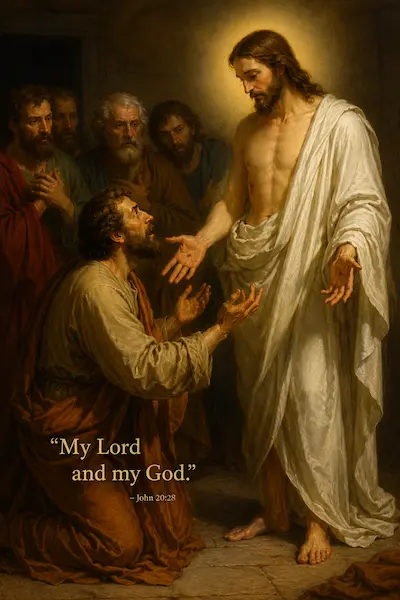
After the Resurrection, Thomas was absent when Jesus appeared to the disciples. He refused to believe on the testimony of others. Eight days later, Jesus returned and invited Thomas to touch His wounds. Thomas did not need to — he saw, and he made the confession that crowns the Gospel of John: “My Lord and my God” (John 20:28).
For this reason, Saint Thomas remains a powerful intercessor for those who struggle with doubt, questions of faith, spiritual dryness, or the desire for a deeper encounter with Christ.
According to ancient tradition preserved in the Acts of Thomas and the living memory of the Thomas Christians of India, Thomas traveled to the Indian subcontinent, founded Christian communities in Kerala, and was martyred near Chennai (formerly Madras) around 72 AD. His feast day is July 3.
Why Pray This Novena?
This novena is especially powerful for:
- Those struggling with doubt or questions about faith
- Those who find it difficult to believe without evidence
- Those who have left the Church and are finding their way back
- Anyone who needs courage to follow Christ into difficult situations
- Missionaries and those who bring the Gospel to new places
- Those seeking a more personal, honest relationship with God
- Those experiencing spiritual dryness or a crisis of faith
- Preparation for the Feast of Saint Thomas — July 3
How to Pray the Novena
Begin on June 24 to finish on July 2, the eve of his feast. Or pray it at any time of year when you are struggling with faith or seeking a deeper encounter with Christ.
- Begin with the Sign of the Cross
- Read the Scripture passage for the day slowly
- Pray the prayer for the day
- Conclude with an Our Father, Hail Mary, and Glory Be
- Ask Saint Thomas to intercede for your specific intention
Novena Prayers — Day by Day
Day 1 — The Call: Following Into the Unknown
“Jesus said to him, ‘Follow me.'” — John 21:22
Thomas did not follow Jesus because everything was clear. He followed before he understood, before he could see where the road led. The call came first. The understanding came later — much later, after failure, after absence, after the wounds.
Lord Jesus, You called Thomas before he was ready. You call me the same way — before I have all the answers, before the path is clear, before I feel worthy or prepared. Give me the grace to say yes to Your call today, even in the uncertainty. Let my following be real, not just theoretical — a movement of the whole life toward You, not just a movement of words.
Saint Thomas, pray for us.
Our Father. Hail Mary. Glory Be.
Day 2 — Courage: “Let Us Also Go”
“Thomas said to his fellow disciples, ‘Let us also go, that we may die with him.'” — John 11:16
Jesus had announced He was returning to Judea, where people had recently tried to stone Him. The disciples were afraid. It was Thomas who spoke — not with false optimism, but with clear-eyed courage. He knew the risk. He chose to go anyway, out of love.
Lord Jesus, give me the courage of Thomas — not the courage that pretends danger does not exist, but the courage that sees it clearly and chooses You anyway. Where following You costs something — comfort, approval, security, safety — let me be willing to pay that price. Not because I am brave, but because You are worth it.
Saint Thomas, pray for us.
Our Father. Hail Mary. Glory Be.
Day 3 — The Honest Question: “We Do Not Know the Way”
“Thomas said to him, ‘Lord, we do not know where you are going. How can we know the way?'” — John 14:5
Jesus had just told the disciples He was going to prepare a place for them and that they knew the way. Thomas said what the others were perhaps thinking but did not dare to say: we do not know. His honesty opened the door to one of the greatest revelations in the Gospel: “I am the way, and the truth, and the life.”
Lord Jesus, I bring You my honest questions today. The ones I am afraid to ask. The ones that make me feel like a bad Catholic or a weak believer. Thomas asked, and You answered with the deepest truth. Receive my questions the same way — not with impatience, but with the answer that only You can give. Let my honesty be the door through which Your truth enters.
Saint Thomas, pray for us.
Our Father. Hail Mary. Glory Be.
Day 4 — The Absence: When We Are Not There
“Thomas, one of the Twelve, called the Twin, was not with them when Jesus came.” — John 20:24
We do not know why Thomas was absent. The Gospel does not say. But his absence meant he missed the moment that changed everything for the other disciples. He came back to find them transformed by something he had not seen. His doubt was not stubbornness — it was the loneliness of someone who had not been there.
Lord Jesus, there are moments when I have not been there — when grace passed and I was elsewhere, when the community was gathered and I was absent, when You came and I missed You. Do not let my absences be permanent. Come back, as You came back for Thomas. Find me where I am and offer me what I missed. Your mercy does not expire.
Saint Thomas, pray for us.
Our Father. Hail Mary. Glory Be.
Day 5 — The Declaration: “I Will Not Believe”
“Unless I see in his hands the mark of the nails and place my finger into the mark of the nails and place my hand into his side, I will never believe.” — John 20:25
Thomas did not pretend. He did not say “maybe” or “I’m not sure.” He said: I will not believe unless I see. This is not cynicism — it is the declaration of a man who loved Jesus too much to accept a secondhand resurrection. His standard was high because his loss had been real.
Lord Jesus, I understand Thomas. There are things I find hard to believe — not because I do not want to, but because the evidence feels insufficient, the wounds too recent, the absence too real. Meet me in my honest resistance. Do not ask me to pretend. Ask me only to remain — to stay in the community, to keep showing up, until You come back and show me what I need to see.
Saint Thomas, pray for us.
Our Father. Hail Mary. Glory Be.
Day 6 — Eight Days: The Patience of God
“Eight days later, his disciples were inside again, and Thomas was with them.” — John 20:26
Eight days passed. Jesus did not appear immediately to correct Thomas. He waited. And in those eight days, Thomas stayed — he did not leave the community, he did not abandon the disciples. He remained with his doubt, in the company of those who believed. And then Jesus came.
Lord Jesus, thank You for the eight days. Thank You for not forcing my faith before it was ready. Thank You for the patience that waits while I struggle, that does not abandon me in my doubt, that comes back when the time is right. Give me the perseverance of Thomas — to remain in the community even when I am not sure, to keep showing up even when I have questions, to trust that You will come.
Saint Thomas, pray for us.
Our Father. Hail Mary. Glory Be.
Day 7 — The Wounds: Touching What Is Real
“Put your finger here, and see my hands; and put out your hand, and place it in my side.” — John 20:27
Jesus did not appear and say: your doubt was wrong, here is proof. He appeared and showed Thomas His wounds. The Resurrection was not the erasure of the suffering — it was the transformation of it. The wounds remained. They became the evidence. Thomas did not need to touch them. Seeing was enough.
Lord Jesus, You showed Thomas Your wounds. You show me Yours too — in the Eucharist, in the suffering of others, in the places where love has cost something. Let me recognize You there. Let me not look for a resurrection without wounds, a faith without cost, a God who has not suffered. You are the one who was pierced. That is why I can trust You with my own wounds.
Saint Thomas, pray for us.
Our Father. Hail Mary. Glory Be.
Day 8 — “My Lord and My God”: The Confession
“Thomas answered him, ‘My Lord and my God!'” — John 20:28
No other apostle in the Gospels makes this confession. Not Peter, not John, not any of those who were present on Easter evening. It was Thomas — the doubter, the absent one, the one who demanded evidence — who looked at the risen Christ and said the most complete thing that can be said: My Lord and my God. His doubt had brought him further than easy faith might have.
Lord Jesus, I want to make Thomas’s confession my own today. Not as a formula, but as a recognition — that You are Lord over my life, my doubts, my failures, my future. That You are God — not a helpful concept or a spiritual practice, but the living God who rose from the dead and stands before me now. My Lord and my God. Let those words be true in how I live, not just in what I say.
Saint Thomas, pray for us.
Our Father. Hail Mary. Glory Be.
Day 9 — The Mission: Faithful to the End
“As the Father has sent me, even so I am sending you.” — John 20:21
Thomas traveled further than any other apostle. Ancient tradition — preserved in the living memory of the Thomas Christians of Kerala, India — holds that he brought the Gospel to the Indian subcontinent, founded communities that survive to this day, and was martyred near what is now Chennai around 72 AD. The man who doubted became the man who went furthest.
Lord Jesus, through the intercession of Saint Thomas, send me where You will. I bring before You the intention I have carried through this novena: [mention your intention here]. I place it in the hands of the apostle who doubted and then gave everything. If You can send Thomas to India, You can do what seems impossible in my own life. I trust You. My Lord and my God.
Saint Thomas, pray for us.
Our Father. Hail Mary. Glory Be.
About Saint Thomas the Apostle
Saint Thomas the Apostle is venerated in the Catholic Church as one of the Twelve chosen by Jesus. His feast day on July 3 was extended to the universal Roman Rite in 1969. He is the patron saint of India, architects, and those who struggle with doubt.
The Thomas Christians of Kerala, India — one of the oldest Christian communities in the world — trace their origin directly to the missionary work of Saint Thomas in the first century. His tomb is venerated at the Basilica of Saint Thomas in Chennai (formerly Madras), India.
His example reminds the Church that doubt, honestly brought before God, is not the opposite of faith — it can be its doorway.
Related Devotions
- Prayer to Saint Thomas the Apostle — A short Catholic prayer for faith and doubt
- Prayer to Saint Paul for Conversion — For those far from faith
- Novena to Saints Peter and Paul — The other great apostolic witnesses
- Catholic Prayer for Impossible Situations — When you need God to intervene
Frequently Asked Questions
July 3, every year. It is a feast day in the Roman Rite, extended to the universal Church in 1969.
According to ancient tradition preserved by the Thomas Christians of Kerala, Saint Thomas brought the Gospel to India in the first century, founded Christian communities there, and was martyred near what is now Chennai around 72 AD.
No. The Church has never condemned Thomas for his doubt. Jesus did not rebuke him — He showed him His wounds. Thomas’s example teaches us that honest doubt, brought sincerely before God, can lead to a deeper faith than easy certainty.
Begin on June 24 to finish on July 2, the eve of his feast. You can also pray it at any time of year for faith, courage, or spiritual renewal.