He is remembered for one moment — the moment he said he would not believe unless he touched the wounds. We call him Doubting Thomas, as if doubt were the whole story. But the story does not end there. It ends with Thomas falling to his knees before the risen Christ and saying: “My Lord and my God.” No other apostle in the Gospels makes that confession. The one who doubted most became the one who confessed most clearly. If you are carrying doubt today, Thomas knows the way through it.
Who Was Saint Thomas the Apostle?
Thomas — also called Didymus, meaning “the twin” — was one of the Twelve Apostles chosen by Jesus. He appears several times in the Gospel of John with a striking honesty: when Jesus announces He is going to Judea despite the danger, Thomas says to the other disciples, “Let us also go, that we may die with him” (John 11:16). This is not a man without courage. This is a man who loved Jesus enough to face death with Him.
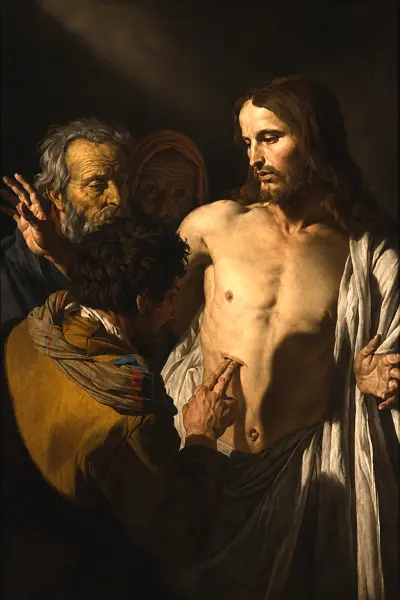
After the Resurrection, Thomas was absent when Jesus appeared to the other disciples. When they told him they had seen the Lord, he refused to believe without physical evidence. Eight days later, Jesus appeared again — this time with Thomas present. He invited Thomas to touch His wounds. Thomas did not need to. He saw, and he believed: “My Lord and my God” — the highest confession of faith in the entire Gospel of John.
According to ancient tradition, Thomas traveled further than any other apostle — all the way to India, where he founded Christian communities that still exist today. Ancient Christian tradition also holds that he was martyred near present-day Chennai around 72 AD. His feast day is July 3.
When Should You Pray to Saint Thomas?
- When you are struggling with doubt or questions about faith
- When you need to see before you can believe
- When faith feels intellectual but not personal
- When you want to make a deeper, more personal act of faith
- For those who have left the faith and need to return
- For missionaries and those who bring the Gospel to new places
- On his feast day, July 3
Prayer to Saint Thomas the Apostle
Saint Thomas,
you who said, “I will not believe,”
and then fell to your knees and said,
“My Lord and my God” —
intercede for me today.
You know what it is to doubt.
You know what it is to need more than words,
more than the testimony of others,
more than secondhand faith.
You asked to touch the wounds.
Jesus did not rebuke you.
He showed them to you.
Pray for me in my own doubts —
the ones I speak out loud
and the ones I am afraid to admit.
Pray that I may see what I need to see,
and that when I see it,
I may fall to my knees as you did
and say with my whole heart:
“My Lord and my God.”
I bring before you this intention:
[mention your intention here]
Saint Thomas, pray for us.
Amen.
How to Use This Prayer
Pray it on July 3, the feast of Saint Thomas, or any time you are struggling with faith or doubt. It can also be prayed for someone you love who has walked away from the Church — Thomas shows us that doubt is not the end of the story.
Related Prayers
- Prayer to Saint Paul for Conversion — For those far from faith
- Prayer for Courage to Begin Again — For new beginnings in faith
- Catholic Prayer for Impossible Situations — When you need God to intervene
- Divine Mercy Prayer for Urgent Help — For moments of desperate need
Frequently Asked Questions
Saint Thomas is called “Doubting Thomas” because he refused to believe in the Resurrection until he saw Jesus for himself. However, his story does not end with doubt. When Jesus appeared to him, Thomas made one of the strongest professions of faith in the Gospels: “My Lord and my God.”
Yes. Saint Thomas is often invoked by those who are experiencing doubt, spiritual dryness, or questions about faith. His example reminds us that honest questions can lead to a deeper relationship with Christ when we continue seeking Him with sincerity.
When Saint Thomas said, “My Lord and my God” (John 20:28), he recognized Jesus not only as his teacher, but as the risen Lord and the Son of God. His words are considered one of the clearest professions of faith in Christ found in the New Testament.