Novena to Saint Benedict
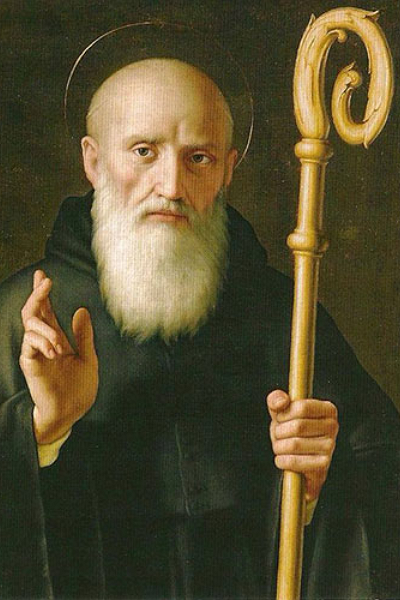
There is a saint the Church has invoked for fifteen centuries against evil, temptation, and the spiritual battles that draw us away from God. Saint Benedict of Nursia did not seek power or influence — he sought God, in silence, in a cave, alone. And from that solitude came one of the most enduring spiritual traditions in Christian history. If you are facing something you cannot name, something that disturbs your peace or pulls you away from God, this novena is for you.
Historical Context — Saint Benedict and the Birth of Western Monasticism
Benedict of Nursia was born around 480 AD in Umbria, central Italy, into a noble family. As a young man he was sent to Rome for his education, but the moral disorder he found there troubled him deeply. He abandoned his studies and retreated to the mountains of Subiaco, where he lived as a hermit in a cave for three years — praying, fasting, and seeking God in radical solitude.
Word of his holiness spread. Communities of monks began to gather around him, and he eventually founded twelve monasteries. Around 529 AD, he established the great monastery of Monte Cassino, which became the mother-house of Western monasticism. There he wrote the Rule of Saint Benedict — a practical, humane guide to communal Christian life, built on the principle Ora et Labora: Pray and Work.
Pope Gregory the Great, who wrote the only surviving biography of Benedict, described him as a man “who shone in this world with such brightness of miracles.” The Rule he wrote shaped Christian Europe for centuries and remains the foundational document of Benedictine monasticism to this day.
Saint Benedict died at Monte Cassino around 547 AD, shortly after the death of his twin sister Saint Scholastica. He is the patron saint of Europe, students, monks, and those seeking protection against evil and temptation. His feast day is July 11.
The Medal of Saint Benedict — A Sign of Protection
Among the most widely recognized Catholic sacramentals in the world, the Medal of Saint Benedict carries a history rooted in documented tradition. The medal traces its origins to an episode from Benedict’s own life: when jealous monks attempted to poison him — first through a cup of wine, then through a loaf of bread — Benedict made the Sign of the Cross over each, and the cup shattered while a raven carried the poisoned bread away. From this episode came the association of Saint Benedict with protection against poison and evil.
The medal itself became widely used in the 17th century and was officially approved by Pope Benedict XIV in 1742, who granted special indulgences for its use. The letters inscribed on the medal — CSPB, CSSML, NDSMD, VRSNSMV, SMQLIVB — form the exorcism prayer attributed to Saint Benedict, invoking his protection against the power of the enemy.
Today the Medal of Saint Benedict is one of the most used sacramentals in the Catholic world — worn by the faithful, placed in homes, buried in the foundations of buildings. It is a sign not of superstition, but of trust: that the God who protected Benedict in his cave, at his table, and in his death, continues to protect those who call on him through his servant.
Why Pray the Novena to Saint Benedict?
Many of us turn to Saint Benedict during times of spiritual struggle, temptation, anxiety, or unrest. His life reminds us that lasting peace is found not in escaping difficulties, but in remaining close to God through prayer, discipline, and trust.
This novena is often prayed:
- For protection against temptation and spiritual attacks
- For peace in the home and family
- For strength during difficult trials
- For perseverance in prayer and daily duties
- For guidance when seeking God’s will
- For those who wear or keep the Saint Benedict Medal
Through his intercession, we ask God to strengthen our faith, protect us from harm, and help us grow in holiness each day.
How to Pray the Novena to Saint Benedict
This novena can be prayed over nine consecutive days, focusing on your personal intentions. It is especially recommended for protection, spiritual growth, and perseverance in faith.
Novena to Saint Benedict
Opening Prayer
Glorious Saint Benedict,
sublime model of virtue,
pure vessel of God’s grace!
Behold me humbly kneeling at your feet.
I implore you in your loving kindness to
pray for me before the throne of God.
To you I have recourse in the dangers
that daily surround me.
Shield me against my selfishness
and my indifference to
God and to my neighbor.
Inspire me to imitate you in all things.
May your blessing be with me always,
so that I may see and serve Christ in
others and work for His kingdom.
Graciously obtain for me from God
those favors and graces which I need so much in
the trials,
miseries and afflictions of life.
Your heart was always full of love,
compassion and mercy toward those who
were afflicted or troubled in any way.
You never dismissed without consolation and
assistance anyone who had recourse to you.
I therefore invoke your powerful intercession,
confident in the hope that you will hear my
prayers and obtain for me the special grace and
favor I earnestly implore.
(State your intention
here…)
Help me,
great Saint Benedict,
to live and die as a faithful child of God,
to run in the sweetness of His loving will,
and to attain the eternal happiness of heaven.
Amen.
Frequently Asked Questions (FAQs)
The feast day of Saint Benedict is celebrated on July 11 every year. He is also honored on March 21 in some traditions, the date of his death according to the older calendar.
Saint Benedict is the patron saint of Europe, students, monks, and those seeking protection against evil, temptation, and poisoning. He was declared patron of Europe by Pope Paul VI in 1964.
The Medal of Saint Benedict is one of the most widely used Catholic sacramentals. It bears a cross and inscriptions forming a Latin exorcism prayer attributed to Saint Benedict. It was officially approved by Pope Benedict XIV in 1742 and is worn or placed in homes as a sign of protection against evil.
Begin on July 3 to finish on July 10, the eve of his feast day. You can also pray it at any time of year when you seek Saint Benedict’s intercession for protection, spiritual strength, or guidance.
Related Prayers
- Prayer to Padre Pio for Healing — For healing and intercession in times of illness
- Prayer to Saint Peregrine for Cancer Patients — For those facing serious illness
- Catholic Prayer for Impossible Situations — When you need God to intervene
- Divine Mercy Chaplet — A powerful prayer of trust and mercy